














 Spanish News Today
 Alicante Today
 Andalucia Today


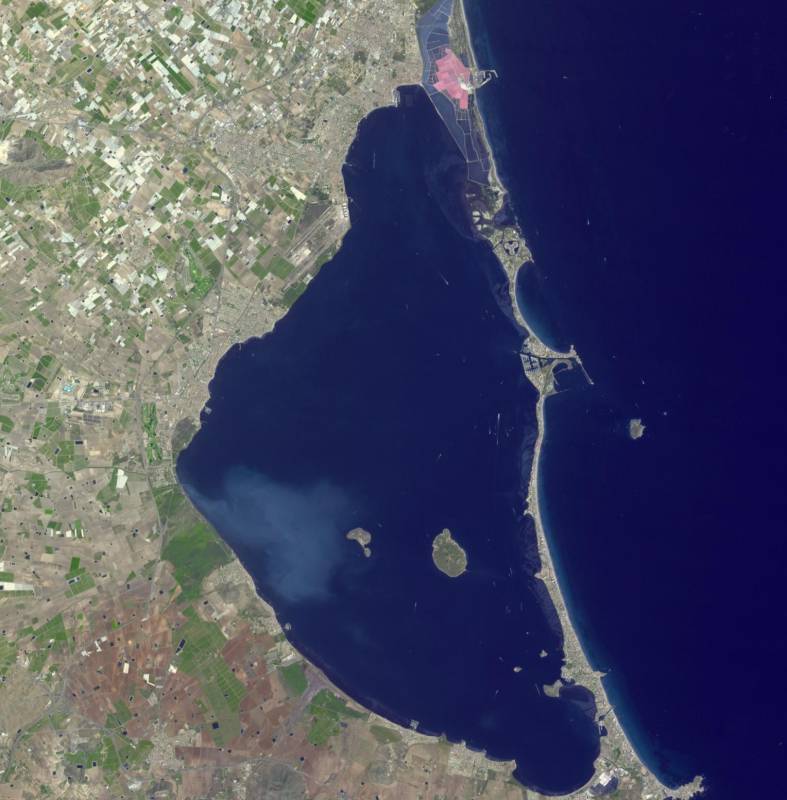
At first glance, it just looks like a strange white patch on the water. But beneath the surface, scientists say something much more worrying is happening.
A new study has found that the Mar Menor's so-called 'white patch' has created an underwater desert covering 12.3 square kilometres. In the worst affected areas, underwater meadows have disappeared completely and the number of fish species has fallen from 21 to just three.
The research, carried out by the Spanish Institute of Oceanography (IEO-CSIC) and the University of Murcia, is the first in the world to show what happens when this type of 'whiting' event continues for years instead of disappearing after a short time.
The white patch has been visible in parts of the Mar Menor since 2022, especially from the air. It's caused by tiny calcite crystals forming in the water after the pH rises, giving the lagoon its cloudy, milky appearance.
The real problem isn't the colour itself. Those tiny particles stop sunlight reaching the seabed and settle on underwater plants, making it much harder for them to survive.
Researchers found the water in the affected area is up to nine times murkier than in healthier parts of the lagoon. As a result, only 3.9% of the sunlight reaching the water's surface makes it to the seabed. In unaffected areas, that figure is 18.3%.
Lead researcher Víctor Orenes-Salazar said: "The scale of the loss of seagrass is particularly worrying. The 'white patch' doesn't simply change the colour of the water. It drastically reduces the light reaching the seabed and continuously deposits calcite particles onto the plants."
Losing underwater vegetation doesn't just affect plants. These seagrass meadows provide shelter, food and breeding grounds for many of the lagoon's fish.
To find out what was happening, researchers monitored more than 4,000 fish over the course of a year, comparing healthy areas with those inside the white patch.The difference was striking.
Healthy parts of the lagoon were home to 21 different fish species. Around the edge of the white patch there were 10. In the centre, researchers found just three.
Species that rely on underwater plants have almost disappeared from the worst affected areas, while hardier fish that can cope with degraded habitats have become far more common.
The researchers say the white patch isn't affecting a healthy ecosystem. It has appeared after decades of habitat loss and environmental change in the Mar Menor, making an already fragile situation even worse.
They say more work is now needed to find out whether the underwater vegetation can recover if the water becomes clearer, or if the damage is too far gone to undo.
Image: NASA